


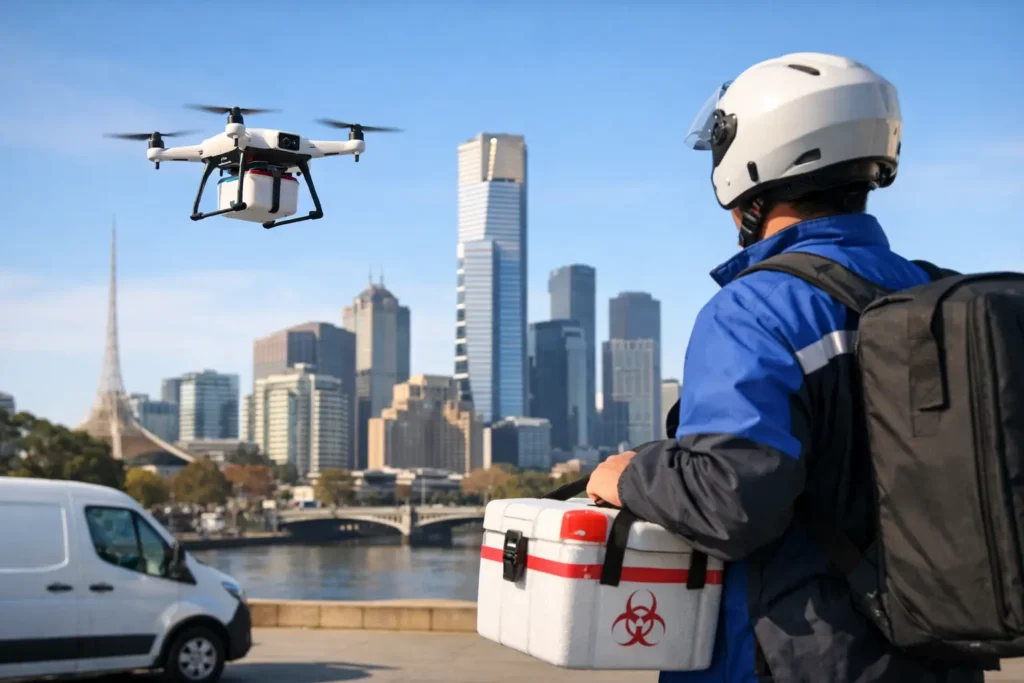
A medical parcel delivery example is rarely just a box moving from one address to another. It may be a pharmacy order needed by a patient at home, essential supplies travelling between a clinic and an aged-care facility, or a time-sensitive item required before a scheduled appointment. In each case, the delivery needs clear instructions, careful handling and a driver who treats the job with the right level of urgency.
For Melbourne businesses, families and health-related services, a professional taxi delivery can provide a practical option when a parcel needs direct transport without waiting for a standard courier run. The priority is simple: collect the correct item, travel directly where required, and deliver it to the right person or authorised receiving point.
Medical Parcel Delivery Example: From Pharmacy to Patient
Consider a common situation. A pharmacy in Richmond has prepared a prescription order for a customer who is recovering at home in Brighton. The customer cannot easily collect it, and the medication is needed that afternoon. Rather than place the parcel into a general delivery network with an uncertain arrival window, the pharmacy arranges a dedicated medical parcel delivery.
At booking, the sender provides the collection address, delivery address, contact names and mobile numbers for both locations. They also advise whether the parcel must be handed directly to the recipient, left with a carer, or delivered to reception. If there is a preferred delivery time, that should be stated at the start, along with practical access details such as unit numbers, gate instructions or a secure entrance.
The pharmacy packs the order appropriately and labels it clearly. The driver arrives at the agreed collection point, confirms the collection details, and loads the parcel safely into the vehicle. For a direct service, the trip then proceeds to the delivery address without unnecessary stops or transfers between vehicles.
On arrival, the driver follows the delivery instructions. If the parcel requires a handover, the driver contacts the recipient or authorised person and confirms that it has been received. If nobody is available, the next step depends on the instructions supplied by the sender. The item should not be left unattended unless the sender has specifically approved a safe location and the nature of the parcel makes that appropriate.
That is the value of a well-organised medical delivery. The sender knows who collected the parcel, the recipient has a clear expectation of arrival, and the transport is managed as a direct point-to-point job rather than an anonymous consignment.
What Makes Medical Parcel Transport Different?
Medical-related deliveries call for more care than everyday document or retail parcels. The contents may be confidential, temperature-sensitive, fragile or needed within a narrow timeframe. A delay may cause inconvenience for a patient, disrupt a clinic schedule or leave a care team without necessary supplies.
This does not mean every medical item requires specialised clinical transport. It depends on what is being carried. A sealed pharmacy order, paperwork, small medical device or packaged care supply may be suitable for a dedicated taxi parcel service. Items requiring controlled temperature monitoring, hazardous-material handling, laboratory chain-of-custody procedures or clinical refrigeration need an appropriately specialised provider.
The sender should always identify any special handling requirements before booking. That helps the transport provider assess whether the job is suitable and allocate the right vehicle and timing. Clear information is not a formality. It prevents avoidable delays at collection and gives everyone confidence about how the parcel should be handled.
Information That Helps a Delivery Run Smoothly
A medical parcel booking is strongest when the details are complete from the beginning. The collection and delivery addresses are essential, but they are only part of the picture. A professional driver also benefits from knowing the name of the person releasing the parcel, the recipient or authorised contact, the size of the item and whether a direct handover is required.
Timing matters as well. Some deliveries need to arrive before a pharmacy closes, before a patient leaves for an appointment, or during a care facility’s receiving hours. If the parcel has a genuine deadline, communicate it clearly rather than assuming an urgent delivery means the same thing to every party.
For apartment buildings, hospitals, clinics and aged-care residences, access instructions can save valuable minutes. Include the appropriate entrance, level, reception name, parking guidance and a contact number that will be answered. A driver can deliver efficiently only when the recipient is ready and the final handover point is clear.
Privacy should be considered throughout the process. Keep labels factual and discreet, avoid placing unnecessary personal information on the outside of the parcel, and provide sensitive details directly during booking where possible. The parcel should be securely sealed before collection, with the sender responsible for correct packaging and any required documentation.
Choosing Direct Delivery Over a Standard Courier
A standard courier may suit routine, non-urgent consignments travelling on a wider delivery schedule. It can be economical for bulk dispatches and parcels with flexible arrival times. But for a medical item needed the same day, direct taxi delivery offers a different service model.
With a dedicated vehicle, the parcel is collected and taken to its destination as arranged. There are fewer handling points, no depot processing and no uncertainty about whether the parcel will sit in a delivery queue. This can be particularly useful for local trips between suburbs such as Hawthorn, Richmond, Cheltenham and Parkdale, or for a longer run to regional Victoria when timing is critical.
There is a trade-off. A direct service is designed around speed, attention and individual collection-to-delivery coordination, rather than the lower cost structure of a multi-stop courier network. For urgent or sensitive deliveries, many organisations consider that added certainty worthwhile.
When a Taxi Is the Right Vehicle for the Job
The best vehicle depends on the parcel, not just the destination. Small sealed packages, documents and pharmacy collections can often travel securely in a sedan. Larger cartons, equipment or multiple parcels may require a wagon, SUV or maxi cab to allow safe loading and prevent items shifting during the trip.
A good booking process considers these practical requirements before dispatch. If the parcel is bulky, unusually shaped or needs to remain upright, explain this when arranging collection. A larger vehicle may be the more sensible choice, even for a short Melbourne delivery.
The driver’s role is to transport the parcel professionally and according to the sender’s instructions. They are not a substitute for medical staff, pharmacists or emergency services. If a patient requires urgent clinical assistance, call emergency services rather than relying on a parcel delivery to resolve the situation.
A Reliable Process for Business and Personal Deliveries
Medical parcel transport can support pharmacies, medical practices, disability support providers, aged-care teams, corporate health services and individual households. The common requirement is reliable coordination. The person booking needs to know that collection will occur as arranged, while the recipient needs straightforward communication about when and how the parcel will arrive.
Melbourne Silver Taxi Cab can assist with pre-booked and time-sensitive parcel transport across metropolitan Melbourne and surrounding Victorian destinations. Professional drivers, a varied fleet and 24/7 availability provide practical flexibility when an item needs to move outside ordinary courier schedules.
For the best outcome, book as early as possible when timing is fixed, prepare the parcel before the vehicle arrives and make sure both collection and delivery contacts are available. A well-prepared medical parcel delivery is not complicated, but the details matter. When every instruction is clear, the delivery can remain focused on what matters most: getting an essential item safely to the person waiting for it.